
If Only Some Use AI, It Will Only Work For Some
 by Katrine Bach, Co-founder & CEO of Connected Women in AI
You may see AI as a mirror - reflecting the world we have already built, including our biases.
That framing is becoming more and more familiar. We see it in the occupational stereotypes generative models reproduce and in the historical patterns embedded in training data.
But the reflection goes deeper than imagery.
Across the labour market, participation remains highly gender-segregated. Women represent roughly one third of data scientists, around one quarter of software engineers, and closer to one in ten AI researchers. In contrast, care-based professions remain overwhelmingly female, with women making up around 80–90% of the workforce. Leadership roles sit somewhere in between, still heavily male-dominated.
These participation patterns do not stay confined to the labour market. They shape the data, behaviours, and signals that AI systems learn from.
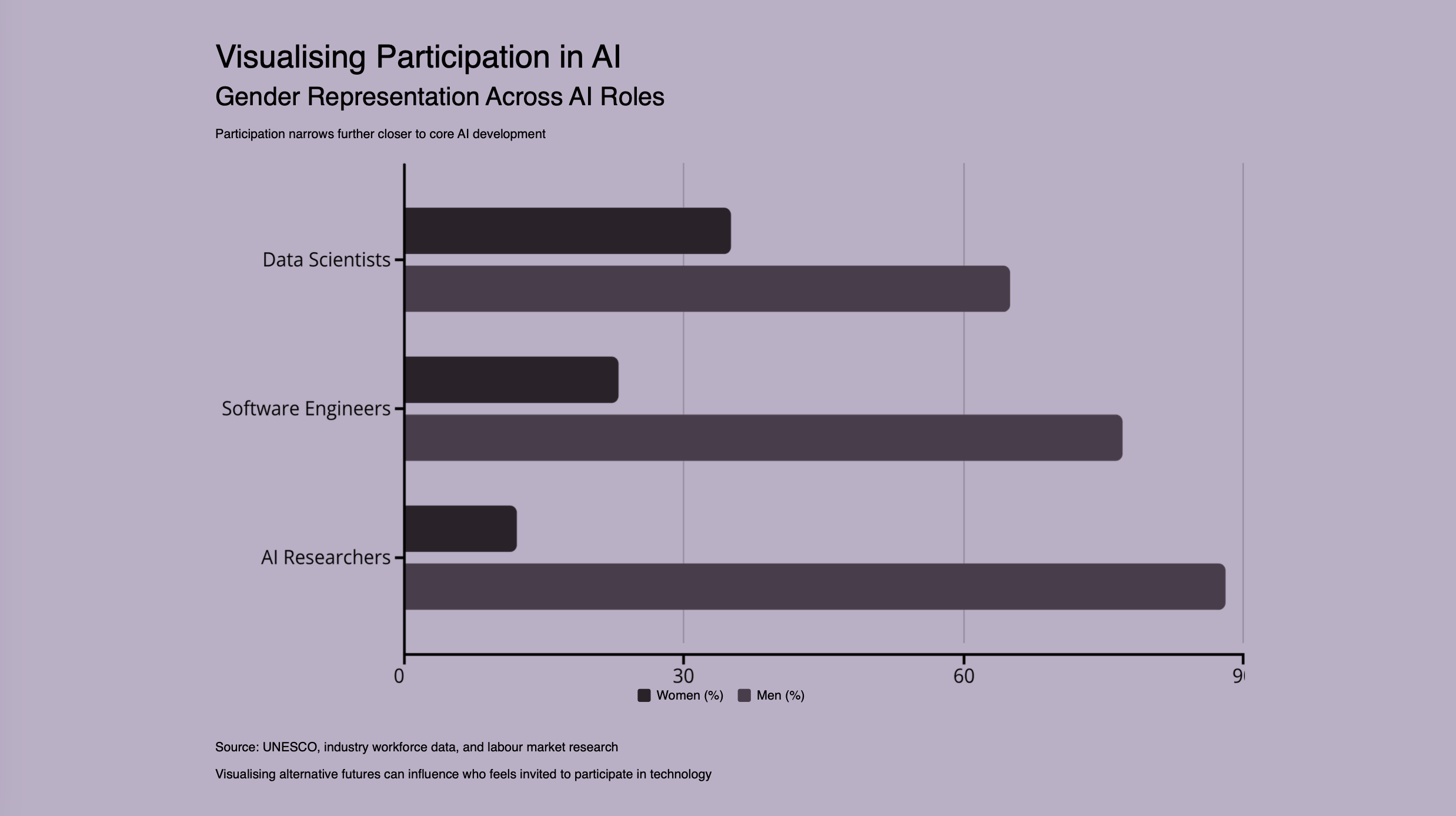
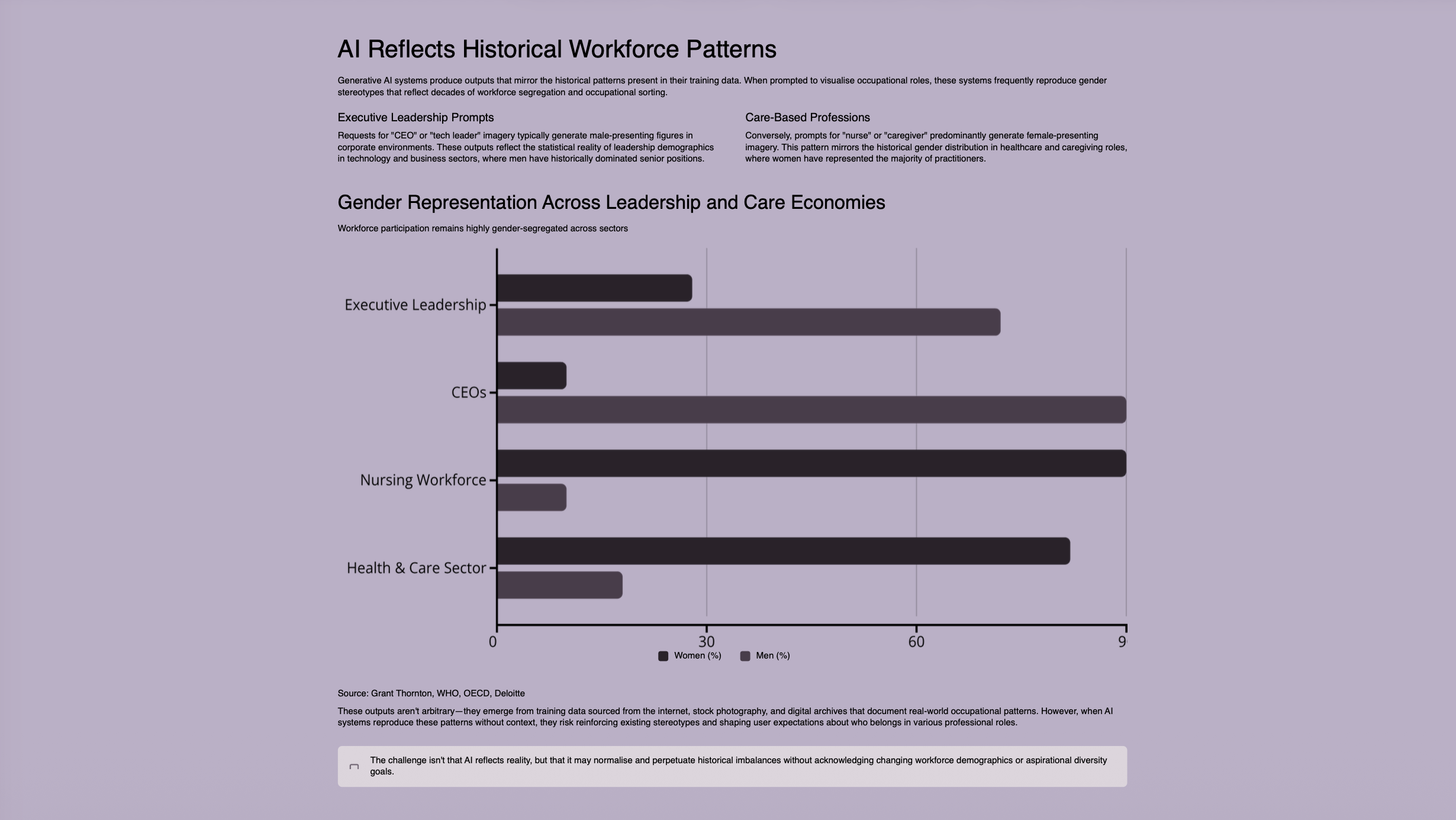 Participation narrows closer to core AI development roles, while care professions remain highly feminised — shaping the data and behaviours AI learns from.
Participation as signal
Conversations about algorithmic bias often focus on datasets; what went in, what was missing and how historical inequities became encoded.
Yet modern AI systems are not static. They are refined through interaction. Through prompts, corrections, enterprise deployment and behavioural feedback.
Usage patterns influence which features improve, which outputs are refined and which applications scale. Over time, engagement itself becomes signal.
So the relevant question is widening: not only what data trained the system, but whose behaviour continues to shape it.
The adoption gap
Participation patterns are already uneven.
Women remain underrepresented in AI-related roles, but the gap is equally visible in adoption. Research shows women are significantly less likely to use generative AI tools at work with overall usage gaps estimated at around 30%. Even when comparing men and women in the same organisations, performing similar tasks, women are still around 16 percentage points less likely to use these tools.
From a systems perspective, lower engagement translates into lower influence over how AI tools evolve in practice.
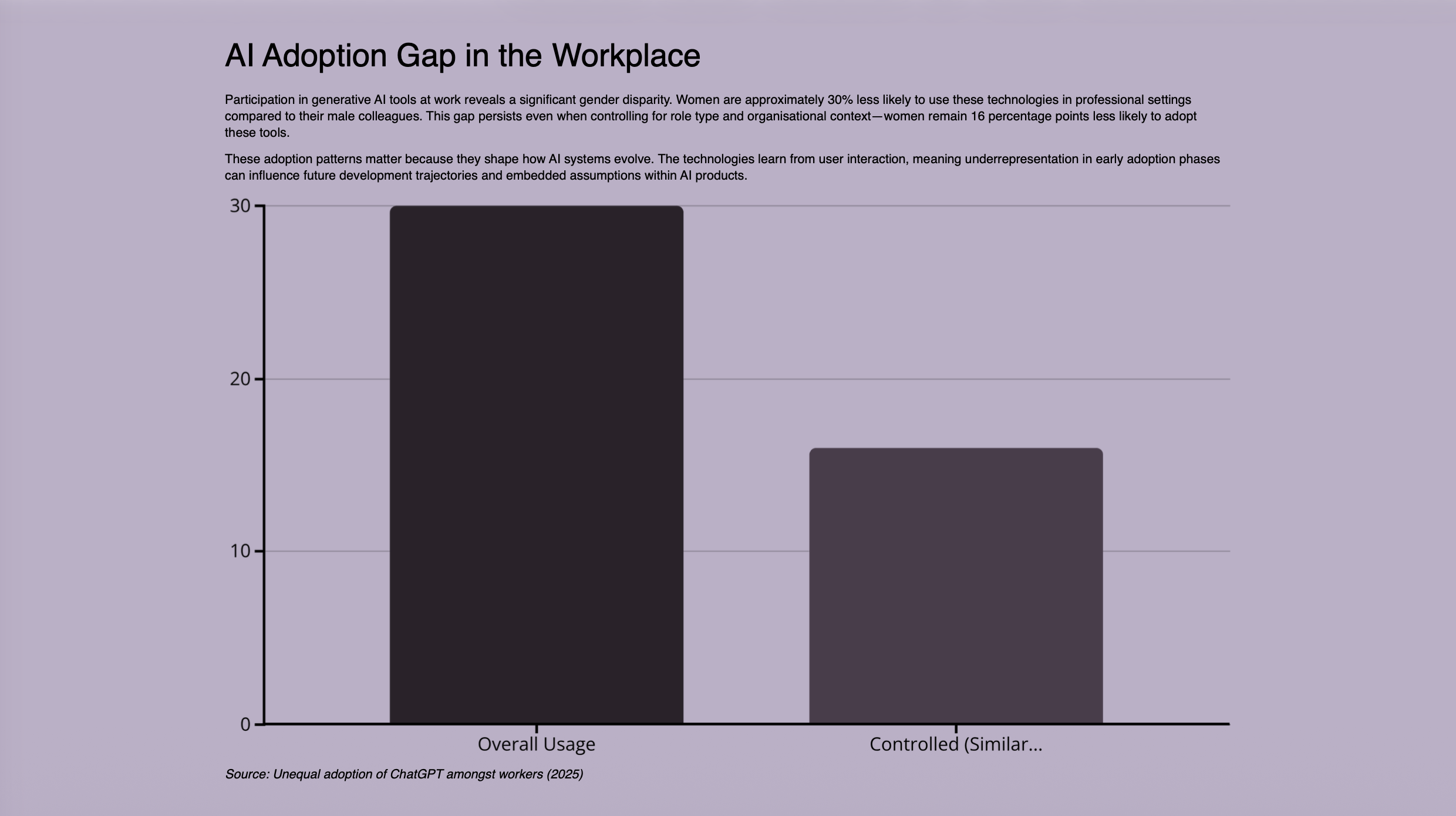 Women are significantly less likely to use generative AI tools at work - both overall and in comparable roles.
Confidence and familiarity shape engagement
Adoption does not happen in a vacuum. Perception and confidence play a role in shaping who engages early and who holds back.
According to a recent Connected Women in AI x Ipsos study:
54% of men say they understand AI well, compared to 43% of women
47% of men report qualified familiarity with AI tools, versus 33% of women
These differences reflect exposure and encouragement more than capability, but they still influence who experiments, who builds fluency and who shapes usage patterns over time.
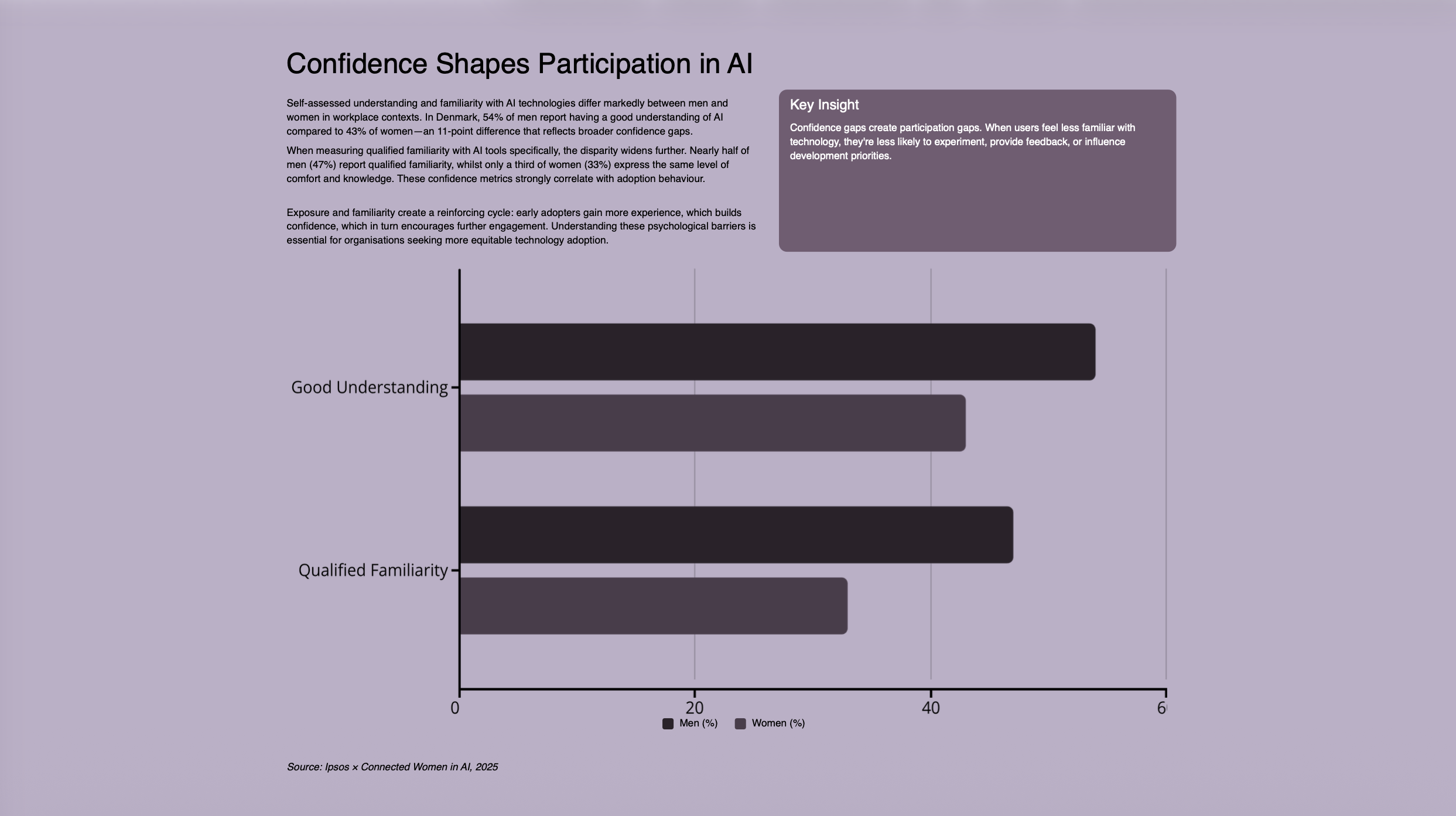 Confidence and familiarity gaps influence early engagement with AI technologies.
AI is learning from how work is done
Generative AI is increasingly embedded in knowledge work. Studies show that most usage centres on writing, information synthesis and decision support.
These functions sit close to the operational core of organisations, shaping communication, analysis, and decision framing.
Which means participation gaps do not only affect representation. They affect the behavioural inputs feeding into AI systems as they mature.
Over time, that influences what gets optimised, automated and prioritised.
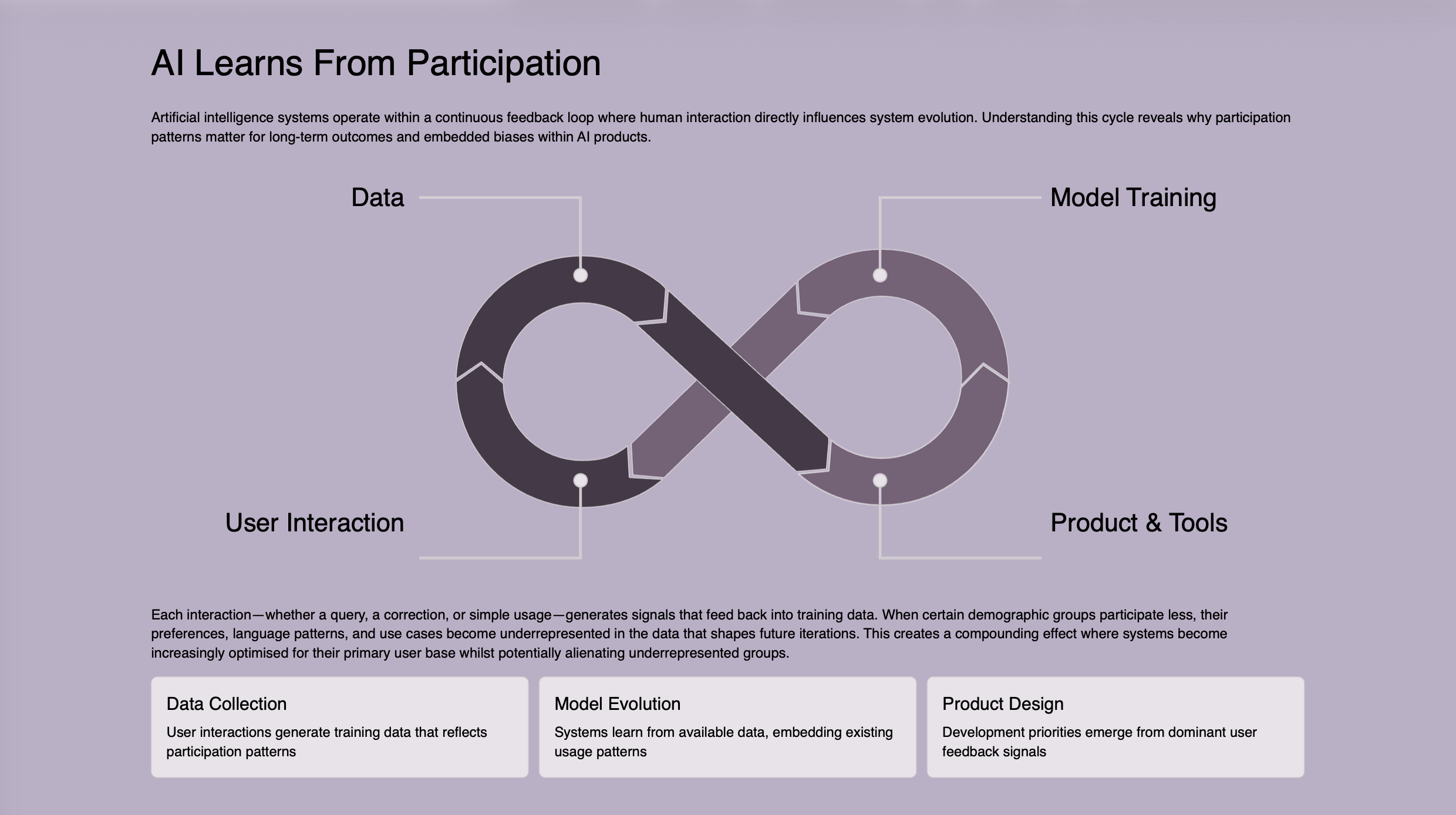 AI systems continuously learn from the people who interact with them.
Representation as system performance
This is where the framing begins to shift.
Representation in AI is often approached as a hiring or pipeline issue. Important, but incomplete.
Because participation also shapes product design, risk detection, customer insight, and governance frameworks. Systems trained and refined through narrow participation are more likely to reproduce narrow assumptions. Broader participation expands testing conditions, use cases and risk awareness.
Representation, in this context, becomes less symbolic and more functional and a part of system performance.
Participation begins earlier than hiring
Participation gaps rarely begin in organisations. They emerge earlier, in perception and identity.
In Denmark today, only about one third of people can see themselves in a role where AI plays a central part.
That signals more than a skills gap. It reflects who feels invited into technological futures and who does not instinctively recognise themselves within them.
People rarely move toward spaces they cannot first visualise themselves inhabiting.
Pattern breaks - however small
This is part of what makes initiatives like Reimagine relevant. By inviting people to visualise themselves in technological roles they may not naturally associate with, the project operates at the level of perception rather than policy.
Not as a structural solution, but as a reminder that participation often begins with recognition.
The moment someone sees themselves reflected in a space that once felt distant.
The systems question ahead
As AI becomes embedded across sectors, leaders are facing a broader set of questions.
Not only who is building these systems, but whose behaviours are shaping their refinement, whose feedback loops they learn from and whose perspectives remain underrepresented in their evolution.
Because AI will optimise around the signals it receives and remain blind to those it does not.
The mirror and the multiplier
AI continues to reflect society.
But it also amplifies participation patterns in real time.
Which means the systems taking shape today will be influenced not only by historical bias, but by who engages with them now and who does not.
And if only some people use AI, shape AI, and guide its development…
Then AI will work better for some than for others.
Sources & Data References:
- Unequal adoption of ChatGPT amongst workers (2025)
- Ipsos × Connected Women in AI - Danskernes forhold til AI (2025)
- Chatterji, Cunningham, Deming et al. - How People Use ChatGPT, NBER Working Paper (2025)
- UNESCO - Women in AI Research Statistics
- OECD Health Workforce Data
- World Health Organization - State of the World’s Nursing (2020)
- Grant Thornton - Women in Business Report (2024)